Understanding
the potential of video in an exhibition space as an art form
Sam Taylor-Wood
Born: 4
March 1967, Croydon
.jpg) Sam Taylor-Wood OBE (born Sam
Taylor-Johnson) is a British filmmaker, photographer and visual artist. Her
work focuses on using film and photographer to draw out and examine our social
and psychological conditions as humans. An example of one of her pieces of work
is her exhibition at the White Cube called Sigh
(2008).
Sam Taylor-Wood OBE (born Sam
Taylor-Johnson) is a British filmmaker, photographer and visual artist. Her
work focuses on using film and photographer to draw out and examine our social
and psychological conditions as humans. An example of one of her pieces of work
is her exhibition at the White Cube called Sigh
(2008).
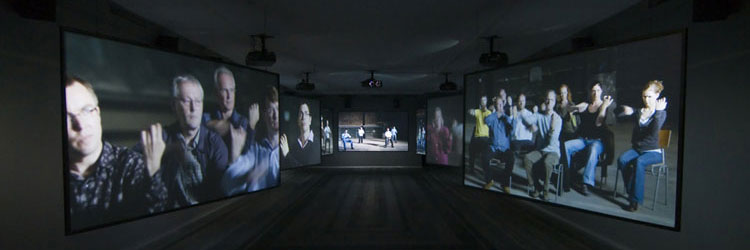
Sigh is an 8 minute long film projected onto 8 different surfaces
that examines the split/difference between individuals personalities and
appearances. Each projection focuses on a different part of the orchestra that
made the score by the Academy-Award winning Anne Dudley as part of the BBC
Concert Orchestra but in her piece, none of the members of the orchestra are
using instruments, and are instead miming as if the instruments are imaginary.
As you move around the room, different screens display different parts of the
orchestra and you are able to experience different perspectives of the sound of
the orchestra depending on where you stand – a masterfully conducted
soundscape. The aim of this piece was to give the audience a sense of loss as they
witness the members of the orchestra play without instruments whilst also
allowing them to stroll through a soundscape.
 This work also contributed to my
idea development as I thought about the ways you could manipulate video and
spacing to alter a person’s perception based on what angle they witness the
piece from. I decided for my social media idea that I would use lighting to my
advantage to help change perception which is similar to the soundscape effect
that she has created in this piece. This piece was highly renowned for its
innovation and creativity.
This work also contributed to my
idea development as I thought about the ways you could manipulate video and
spacing to alter a person’s perception based on what angle they witness the
piece from. I decided for my social media idea that I would use lighting to my
advantage to help change perception which is similar to the soundscape effect
that she has created in this piece. This piece was highly renowned for its
innovation and creativity.
Peter Greenaway
Born: 5
April 1942, Newport

Peter Greenaway is a British film director and artist. His work takes a lot of influence from the Renaissance, Flemish and Baroque painting style. Greenaway is known for his films containing a lot of contrasting and composed imagery containing nudity, nature, sexual pleasure and painful death. He is most well-known for directing the crime film The Cook, the Thief, His Wife & Her Lover (1989).
This film
is about a mobster who acquires a French restaurant in London and every night
scares off potential customers with his rude attitude. Eventually this mobster’s
wife becomes disgusted by him also and decides to have an affair with a restaurant
guest. They attempt to keep their affair a secret but her husband finds out and
decides to plot his revenge. The film is especially noted for the graphic
violence and nudity. This film has received high critic ratings with a 7.6/10
on IMDb and 89% on rotten tomatoes, which for a film is a very good rating.
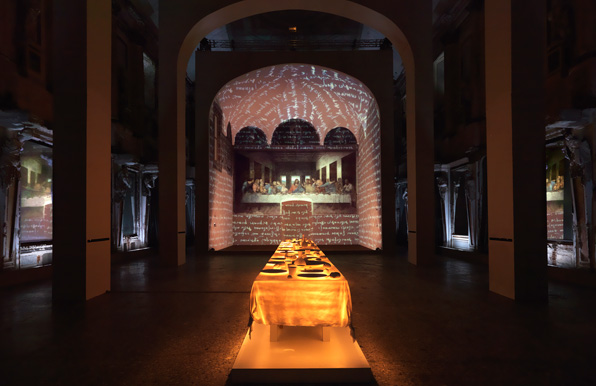
Greenaway is also known for his
ongoing video installation series called Ten
Classic Paintings Revisited in which he attempts to create a comparison “between
8,000 years of art and 112 years of cinema.” One example of this is when he
revisited the painting Leonardo’s Last Supper in a large full-scale replica of
the dome of the Refectory of Santa Maria Delle Grazie in Milan, Italy (where
the original painting was originally housed). Most critics have claimed his
work is utterly distinctive, one of the most amazing experiences and he that
has a bold vision with his work.
Gillian Wearing
Georgina Starr
Audience Comparison
Taylor-Wood's audience would likely consist of people who look to be inspired by art through the medium of film as that is what she specialises in. Her work consists of a lot of artistically charged film so it's no surprise that the audience she appeals to differs greatly from Peter Greenaway's work which focuses more so on the video installation set up itself. Taylor-Wood prefers a style of work that allows the audience to reflect upon what she has produced whereas Greenaway has a more gritty and visceral feel to his work. The audiences are likely to be drastically different in terms of the genres they're searching for. That's not to say that Taylor-Wood's work doesn't include video installation, or that Peter Greenaway's work doesn't include film, simply that that isn't her only venture in art and media, whereas Greenaway would attract more art enthusiasts and critics who are interested in a Renaissance-esque installation instead of film enthusiasts and critics who are interested in art that allows you to reflect upon it. They've both had their fair share of work in both film and art installations.
Gillian Wearing
Born: 1963, Birmingham
Gillian Wearing OBE RA is an
English Conceptual artist and one of the Young British Artists. She won a
Turner Prize in 1997. Her work involves the use of a lot of photography and
video to help document everyday life in public spaces as she tries to blur the
lines between reality and fiction. One example of her pieces named Signs
that say what you want them to say and not Signs that say what someone else
wants you to say, (1992-1993) involved getting random members of the
public to write down what was on their mind on a piece of paper then she would
take a picture of them with their permission as they held that sign up to the
camera. She did this in an attempt to challenge the people she stopped into
challenging their perception of themselves. Her work is critically acclaimed
and has won her multiple awards across the span of her career.
Georgina Starr
Born: 1968, Leeds
Georgina Starr is an English artist
and one of the Young British Artists most well known for her video, sound and
performance installation works. Her work focuses on creating strong narratives
that the audience have to explore and create “something magically complex,
layered and densely referential out of virtually nothing but its own ‘stuff’”.
Her work focuses on a culmination of the topics of dream, fiction and memory. Many
publications have noted her work for being forward thinking and influential as
well as tear jerking and euphoric.
Rachel Maclean
Jeff Keen
Rachel Maclean
Born: 1987, Edinburgh
Rachel Maclean is a multi-media
artist who has a strange and abstract approach to her installations. She
usually takes the main role in her videos and puts on a lot of colourful
costumes and make-up and uses CGI to create the backgrounds that the videos are
set in. She uses a lot of archived audio from old television/cinema to help
construct the narrative of her abstract videos whilst also trying to keep a
comedic tone to it. She has received a lot of positive reviews about her work,
though some have noted that her work make them feel uneasy whilst waking them
up to the narratives she has constructed.
Jeff Keen
Born: 1923, Wiltshire
Jeff Keen was a film-maker, poet
and artist who sadly died at the age of 88 in 2012. He was known for his extremely
original and vast bodies of paintings, drawings and sculptures. Keen loved to
use various techniques such as editing and superimposition. A lot of his pieces
include subliminal messaging and he touched upon a lot of topics such as race
and homosexuality. He included a lot of collage, archival footage, animation
and live action footage in his films to help carry the narratives. His work was
highly regarded by critics as it drew out a lot of emotional responses from the
audiences.
Steve McQueen
Norman McLaren
Steve McQueen
Born: 9th October 1969,
London
Steven Rodney McQueen CBE is an English
film director, producer and video artist. His work is valued by millions and is
regarded as incredibly thought provoking. He was included in the TIME 100 2014
edition as one of the “Most Influential People in the World” and was granted
the BFI (British Film Industry)’s highest honour, the BFI Fellowship, so it is
safe to say his work is hugely successful. His most successful project in
recent years would be the 2013 film, 12 Years a Slave which one multiple awards
across many different awarding bodies. A lot of his work touches upon harsh and
marginal subject matter such as racism, sexuality and addiction.
Norman McLaren
Born: 11th April 1914,
Stirling
Norman McLaren CC CQ was a Scottish
director and animator who favoured the method of animation to create his
artistic films. His films were an amalgamation of hand drawn animation,
pixilation, graphical sound and visual music. One unique technique he used was
to scratch directly onto the film stock
itself to create imagery on top of already filmed footage. His work left a
legacy for filmmakers to experiment with working with imagery in animation and
many workshops have been opened up to teach younger artists in his style of art
and teach people how to blend animation with music. His work has won him
multiple awards across many Canadian and British film bodies.

No comments:
Post a Comment